
Table of Contents
ToggleWhether you’re a hardened League of Legends veteran or someone who just got hooked on the universe through the Netflix series, there’s a good chance you’ve noticed those adorable Funko Pop figures cluttering, er, decorating, shelves everywhere. League of Legends Funko Pops have exploded in popularity over the past few years, and 2026 is shaping up to be a peak year for collectors. These stylized vinyl figures capture the essence of Runeterra’s most iconic champions, and they’ve become more than just toys: they’re legitimate collectibles with growing market value and passionate communities behind them. If you’re thinking about diving into collecting or already have a few champions sitting on your desk, this guide covers everything you need to know: from understanding what makes these collectibles tick to hunting down rare variants, protecting your investment, and eventually selling them for profit.
Key Takeaways
- League of Legends Funko Pop figures have become legitimate collectibles with growing market value, driven by rarity, champion popularity, and condition—with early releases from 2017–2019 appreciating 50–100% since their original retail price.
- Start your collection with figures you genuinely enjoy (your main champion, favorite skin line, or Arcane favorites) rather than chasing rare variants blindly, and set a realistic monthly budget to avoid overspending on secondary market premiums.
- Chase variants and exclusive retailer releases (Hot Topic, Target, GameStop exclusives) are the most valuable Funko Pop variants, with 1-in-6 to 1-in-12 pull rates making them highly sought-after by serious collectors.
- Authenticate League of Legends Funko Pops by inspecting packaging quality, figure paint application smoothness, weight, seller verification, and the copyright stamp on the bottom—counterfeits are common on unregulated marketplaces like AliExpress and suspicious Amazon sellers.
- Preserve resale value by storing Funko Pops in cool, dry, UV-protected locations away from sunlight and humidity; mint-in-box (MIB) condition commands 2–3x the price of out-of-box figures on secondary markets.
- Arcane-inspired League Funko Pop variants appreciated significantly in 2024–2025 following the show’s second season, though momentum has stabilized by early 2026—focus on discontinued skin-line variants and early limited releases for genuine long-term investment potential.
Understanding League of Legends Funko Pops
League of Legends Funko Pops represent a unique intersection of competitive gaming culture and collectible vinyl figures. Unlike standard merchandise that floods every gaming store, Funko Pops have achieved a kind of cultural prestige in the collector community. They’re manufactured to specific quality standards, released in limited quantities (sometimes), and designed with enough detail that even non-gamers recognize the champions immediately.
What Makes Funko Pops Popular Among LoL Fans
There’s something inherently satisfying about owning a physical representation of a digital character you’ve spent hours controlling. For many League players, their main champion feels like an extension of themselves, whether it’s the sniper precision of a Caitlyn main or the flash-and-dash chaos of a Zed player. A Funko Pop on the desk becomes a badge of identity, a conversation starter, and a reminder of countless ranked matches.
Funko’s design philosophy also plays a massive role. The oversized heads, exaggerated features, and distinctive art style somehow capture champion personalities better than hyper-realistic collectibles could. Lux’s golden glow, Ahri’s mystical fox tails, Yasuo’s wind-swept hair, they all come through in the stylized form. Collectors appreciate that Funko doesn’t try to be photorealistic: it leans into personality, which is exactly what League’s roster is built on.
The affordability factor matters too. A standard Funko Pop typically costs $15–$20 retail, making them accessible entry points for collectibles. Compare that to statues or premium figures that can run $50–$200+, and suddenly you can build a meaningful collection without dropping mortgage-payment money.
The Evolution of League Collectibles in the Funko Universe
Funko’s League of Legends line didn’t start massive. Early releases were limited, focusing on the most iconic champions, Ahri, Lux, Garen, Teemo, and a handful of others. Collectors from that era now sit on goldmines, as certain first-run releases have become genuinely scarce.
Over time, Riot Games and Funko expanded the collaboration. More champions got releases, variants started appearing (glow-in-the-dark versions, metallic finishes, chase editions), and exclusives dropped through major retailers like Target, GameStop, and Hot Topic. The 2024–2025 period saw a significant uptick in League-specific Funko content, with K/DA skins, PROJECT skins, and lore-inspired variants hitting shelves. By 2026, collectors are seeing a more sophisticated release strategy: themed waves tied to League events, championship seasons, and Arcane content (which massively boosted interest in champions like Powder/Jinx, Vi, and Caitlyn).
The evolution reflects Funko’s growing understanding of the League fanbase. They’re not just slapping champion logos on generic bodies anymore: each figure gets thoughtful design work that captures the essence of that champion’s kit, aesthetic, and place in Runeterra’s hierarchy.
Complete Guide to Available League of Legends Funko Pop Figures
As of March 2026, the League of Legends Funko Pop catalog has grown significantly. There are now over 50 unique figures in circulation, with variants pushing the total collectible count well over 100. Knowing what’s available, and what’s actually worth hunting for, is crucial before you start spending.
Champion-Specific Releases and Variants
Every major League champion has either a base Funko Pop or multiple variants. Here’s the reality: not every release was created equal. Some champions have gotten multiple variants (sometimes 4–5 different versions), while others got a single base release and nothing more.
Core champion releases include:
- Ahri (multiple variants: standard, K/DA, spirit blossom)
- Lux (standard, Prestige, and skin-line variants)
- Yasuo (base release, Project variant)
- Jinx (multiple versions, heavily boosted by Arcane popularity)
- Vi (standard, Arcane-inspired editions)
- Caitlyn (base and Arcane variants)
- Garen (original release, still highly sought)
- Teemo (the perennial favorite, multiple skin variants)
- Kai’Sa (standard and PROJECT skins)
- Akali (base and K/DA releases)
Variants matter because they create collection depth. A collector serious about their shelf might own three or four different Ahri figures, each representing different skin lines or special editions. This isn’t hoarding: it’s completionism, and it’s taken seriously in collector circles.
Limited Edition and Exclusive Versions
This is where Funko gets interesting. Certain releases are exclusive to specific retailers, and those exclusives often have lower production runs than standard releases. Target exclusives, Hot Topic exclusives, and GameStop exclusives are the main players. These typically have slightly different paint schemes, special packaging, or chase variants that make them distinct from standard retail versions.
Chase variants are the holy grail for collectors. A chase variant is typically a 1-in-6 to 1-in-12 pull, meaning if you buy six blind boxes of a Funko Pop, you might get one chase variant instead of the standard version. Chases often feature alternative paint jobs, special effects (holographic elements, metallic finishes), or rarer character states. Landing a chase can feel like opening a legendary chest in-game.
Certain 2024–2025 releases also featured limited production runs tied to events. Championship-themed Funko Pops released during Worlds seasons, for example, had lower quantities manufactured. These naturally become harder to find as time passes.
Rare and Hard-to-Find Releases
Early-release Funko Pops from the League collaboration (2017–2019 era) are now genuinely scarce. If you can find a first-edition Garen or Teemo from 2017–2018 in mint condition with original packaging (sometimes called “MIB” or “mint in box”), you’re looking at $60–$150 depending on condition and variant.
Certain exclusive releases that had extremely limited retail availability are also valuable. A few examples that experienced collectors obsess over:
- PROJECT skin variants from early releases
- K/DA Ahri (earlier versions, pre-2022)
- Spirit Blossom skin-line Pops (limited distribution)
- League championship commemorative Pops (event-specific, low production)
The rarity factor is real. Unlike video game items, Funko Pops aren’t replicated in-game or duplicated infinitely. Once a batch sells out at retail and doesn’t get restocked, finding one means hunting the secondary market, and prices reflect that scarcity.
One critical point: rarity doesn’t always equal value. A rare Funko Pop that’s visually uninteresting or represents a less-popular champion might hold value for completionists but won’t command the same prices as a sought-after rare variant of Ahri or Lux. Popularity and rarity together drive market prices.
How to Start Your League of Legends Funko Pop Collection
Starting a Funko Pop collection can feel overwhelming. There are dozens of figures, multiple variants per champion, and a thriving resale market with wildly fluctuating prices. But it doesn’t have to be complicated. Smart collectors approach this strategically.
Choosing Your First Figures
Your first purchase should reflect what actually matters to you, not what some internet stranger told you was valuable. If Jinx is your main, grab a Jinx Funko Pop. If you’re obsessed with Arcane, start with Vi, Powder, or Caitlyn. If you want to tap into the broader League aesthetic, any of the iconic champions work, Ahri, Lux, Yasuo, or Teemo are all solid foundational pieces.
The key is buying figures you genuinely want to look at. Collectors who start chasing rare variants before they’ve built emotional attachment to their collection often end up disappointed. You’ll spend more time hunting and less time enjoying.
Consider your display space too. If you’ve got a small desk shelf, start with 3–5 figures. If you’re dedicating a whole bookcase, you can be more ambitious. Cramming 40 Funko Pops into a tiny space defeats the purpose: they deserve room to breathe.
Setting a Budget and Collection Goals
This is where discipline matters. Funko Pop collecting can become expensive quickly, especially once you’re hunting variants and rare releases. Set a monthly or quarterly budget and stick to it. Maybe that’s $50 a month, maybe it’s $200 every three months, it depends on your financial situation.
Once you have a budget, decide what you’re actually collecting toward. Are you building a complete champion roster (all available champions, one version each)? Are you going skin-line deep (every variant of specific skins, like all K/DA releases)? Are you collecting top-tier champions only (just your personal mains and favorites)? These goals determine how you spend and how much you’ll actually need to invest.
Skin-line collectors, for example, might target all K/DA Funko Pops: Ahri, Akali, Evelynn, Kai’Sa. That’s roughly $60–$100 for standard retail versions, or potentially $200+ if you’re hunting specific variants. By contrast, a collector focused on just Arcane champions needs four figures (Jinx, Vi, Caitlyn, Heimerdinger), which is more manageable.
Be realistic about completion too. Completing the entire League Funko Pop catalog (every variant ever made) would require multiple thousands of dollars and years of hunting. That’s a whale-level commitment. Most collectors aim for a subset, a curated selection that brings them joy without becoming a second mortgage.
Where to Buy Authentic League Funko Pops
Finding authentic League Funko Pops is easier than it sounds if you know where to look. The risk, but, is real: counterfeit Funko Pops exist, especially on unregulated marketplaces. Knowing the legitimate channels protects both your wallet and your collection’s resale value.
Official Retailers and Online Marketplaces
Primary retail options for current-release League Funko Pops:
- Hot Topic – Exclusive variants and early access to new releases
- Target – Consistently stocks standard versions and Target-exclusive variants
- GameStop – GameStop exclusives, solid stock of core characters
- Amazon – Legitimate stock from verified sellers (watch out for third-party fakes)
- Walmart – Standard retail availability
- Funko.com – The official Funko store, sometimes carries exclusives
Buying from these retailers guarantees authenticity. You’re paying retail price (usually $15–$20 for standard Pops), but you’re getting legitimate product with proper packaging and the ability to return if there are defects.
For newer releases, tracking release calendars is helpful. Sites like Spawntrek’s League of Legends coverage often mention upcoming Funko releases alongside game news, so staying plugged into League communities keeps you informed about what’s dropping when.
Secondary Markets and Collector Communities
Once you’re hunting specific variants or older releases, the secondary market becomes your playground. This is where rarer Pops change hands, where collectors liquidate duplicates, and where prices can swing wildly.
eBay is the established platform. Thousands of League Funko Pops are listed at any given time. Advantages: huge selection, buyer protection, and seller ratings. Disadvantages: prices are often inflated, shipping can be expensive, and you need to carefully read listings (some sellers misrepresent condition or variants).
Mercari has become popular with younger collectors. It’s more casual than eBay, prices are sometimes more reasonable, and the mobile app makes browsing easy. The downside: less buyer protection, and you’re relying on individual seller reputation.
Facebook Marketplace and collector groups exist but require caution. These are peer-to-peer sales with minimal oversight. You might find deals, but there’s higher risk of scams or misrepresented items.
Reddit collector communities (r/funkopop, League-specific subreddits) sometimes have trading posts. The community is generally trustworthy, but trades mean you’re bartering rather than purchasing, and you lose the platform protection of eBay or Amazon.
Local comic shops and gaming stores often have Funko sections and staff who know the market. Prices might be slightly higher than online, but you get to inspect items before buying, which is huge for grading-conscious collectors.
Avoiding Counterfeits and Fakes
Counterfeit Funko Pops are more common than most people realize, especially on Aliexpress, Wish, and certain Amazon third-party sellers. Here’s how to spot fakes:
Packaging quality: Authentic Funko boxes have crisp, vibrant printing. Fakes often have fuzzy printing, misspelled text, or low-quality paper stock. The Funko logo should be perfect.
Figure quality: Real Funko Pops have smooth vinyl with consistent paint application. Fakes often have sloppy paint lines, bubbles in the plastic, or uneven coloring. Hold a real Pop next to a suspect one, the difference is obvious.
Weight and feel: Authentic Funko Pops have a specific heft and solid feel. Counterfeits are sometimes lighter or feel hollow.
Seller verification: Only buy from established retailers, verified eBay sellers with positive track records, or collector communities with moderation. If a seller has hundreds of complaints, that’s a red flag.
Price too good to be true: If a rare Funko Pop is listed for $10 when market value is $80+, it’s probably fake. Deals exist, but extreme discrepancies warrant skepticism.
One pro tip: request photos of the bottom of the figure if buying secondhand. Authentic Funko Pops have a specific mold stamp on the bottom with model numbers and copyright info. Counterfeiters often ignore this detail, giving themselves away immediately.
When discovering gaming culture through collectibles, many fans dig deeper, exploring the communities around titles like League of Legends and related gaming experiences to enrich their fandom.
Protecting and Displaying Your Collection
Congratulations, you’ve got some League Funko Pops. Now comes the part many collectors skip: proper care. A Funko Pop collection deteriorates quickly if neglected. Sun exposure fades paint, dust accumulates, and boxes deteriorate. Smart collectors treat their Pops like the investments they are.
Storage Solutions for Long-Term Preservation
Funko Pop care depends on whether you’re keeping them in-box or out-of-box. Both approaches have merit, but the premium collectible market favors mint-in-box (MIB) condition for resale value.
In-box storage:
- Store boxes in a cool, dry place away from direct sunlight. UV rays fade paint and box graphics irreversibly.
- Keep humidity controlled. Basements and attics can be problematic due to moisture fluctuations.
- Stack boxes carefully or store them upright on shelves. Crushing damage tanks resale value.
- Use acid-free storage boxes if stacking for extended periods. Cheap cardboard off-gases and damages collectibles.
- Check periodically for signs of pest damage or moisture. An hour every few months prevents disasters.
Out-of-box storage and display:
- Remove Pops from boxes carefully. Some collectors use heat to gently loosen glued sections rather than tearing.
- Display away from direct sunlight. Place shelves in interior wall locations or use UV-protective glass.
- Keep Pops out of humid areas. Bathroom shelves are terrible for collectibles.
- Dust regularly with a soft microfiber cloth. Canned air works too.
- Avoid touching the figure’s face and hands repeatedly, natural oils from skin can wear away paint.
Display Options and Creative Setups
This is where collecting becomes personal expression. Serious collectors build theme-coordinated displays that rival esports trophy cases.
Floating shelves are the classic choice. They’re clean, minimalist, and can be arranged to create visual hierarchy. A center-positioned Lux Funko Pop flanked by Kai’Sa and Ahri creates an obvious focal point.
Detolf glass cabinets (IKEA’s $60 glass cabinet) are beloved by collectible enthusiasts. The doors lock out dust, the glass looks professional, and internal LED strips (purchased separately) create dramatic lighting. A Detolf filled with 15–20 League Funko Pops is Instagram-worthy and protected.
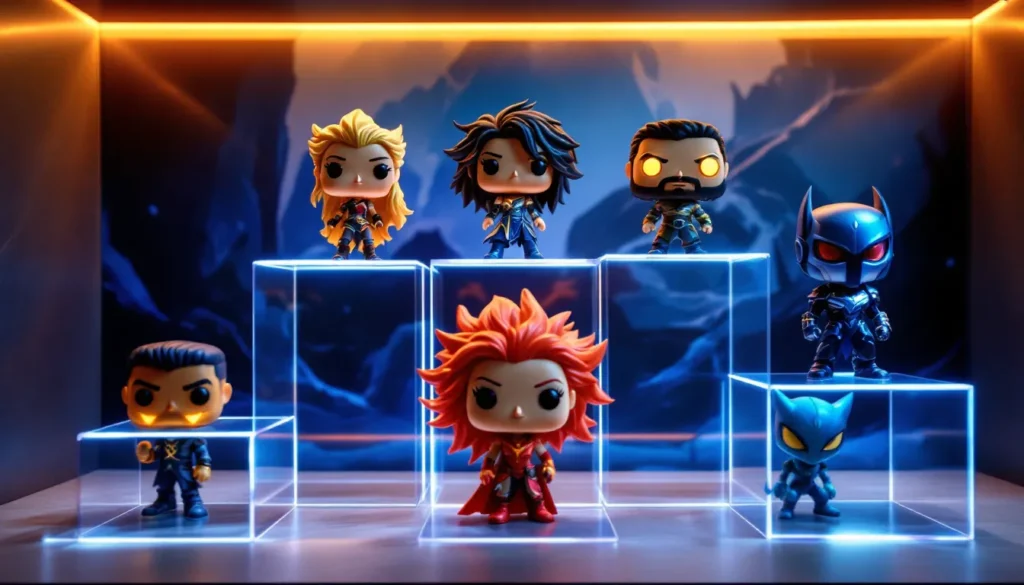
Acrylic risers layer your display vertically, maximizing shelf space. Stagger heights so every Pop is visible. Themed groupings work: K/DA skins on one riser, PROJECT skins on another, Arcane champions in a third section.
Themed backgrounds take displays up a notch. Print high-res League splash art or Arcane screenshots as shelf backdrops. The right background transforms a collection from “toy collection” to “curated shrine.” Many collectors use backdrop materials like foam board or printed canvas.
Lighting matters tremendously. Warm LED strips create ambiance: cool blue lighting emphasizes darker champions like Yasuo or Zed. Smart bulbs let you adjust color temperature throughout the day or even sync with gaming sessions for immersive aesthetics.
Some collectors arrange by role (ADCs together, supports together), others by release date (showing the evolution of Funko’s League line), and others by skin line (K/DA section, PROJECT section, etc.). Your arrangement tells a story about your priorities as a collector.
One note: displaying out-of-box will reduce resale value if you ever decide to liquidate. MIB Pops command premiums. If collection value matters long-term, keep everything boxed and stored properly. If you’re collecting for personal joy and don’t plan to sell, display freely, that’s the whole point of ownership.
Valuation and Investment Potential
This section exists because many people do treat Funko Pops as investments, rightly or wrongly. The secondary market is real, prices fluctuate, and some figures genuinely appreciate. Equally important: some don’t. Understanding the difference between hype and genuine value determines whether you’re building an asset or a sunk-cost collection.
Understanding Market Trends and Pricing
Funko Pop prices are driven by three core factors: rarity, popularity, and condition.
Rarity is objective, how many were produced and how many are still in circulation? Early League Funko Pops from 2017–2019 have lower supply simply because fewer were made. Current releases are more abundant, so they hold lower baseline values.
Popularity is subjective but measurable. Ahri, Lux, and Yasuo Funko Pops consistently demand higher prices because those champions have massive playerbases and cultural cachet. A Teemo Pop might be rarer, but if fewer people want Teemo displayed on their desk, the price won’t reflect scarcity the way an Ahri Pop’s price would.
Condition matters enormously for resale. A MIB Pop with perfect box condition can sell for double or triple the price of an out-of-box figure or a loose Pop with a damaged box. This is why collectors obsess over storage and handling.
Price trends 2024–2026: Arcane-inspired League Funko Pops saw significant appreciation in 2024–2025 following the show’s second season. Jinx, Vi, and Caitlyn figures that were common retail stock climbed to $30–$50 on secondary markets. This wasn’t because they became rare: it was because demand spiked due to renewed cultural relevance. That momentum has stabilized somewhat by early 2026, but Arcane Pops remain stronger performers than pure League-only releases.
Championship-themed Pops released during LoL Esports seasons tend to appreciate during their respective season, then flatten or decline once the season ends. T1-themed Pops or World Champions-specific releases can appreciate if they commemorate a particularly popular team or moment.
Which Figures Hold Value Over Time
Not all Funko Pops are created equal for investment potential. Some genuinely hold or appreciate in value: others depreciate.
Appreciating figures:
- Early releases (2017–2019) with low production runs. These become genuinely scarce over time. A first-edition Garen or Teemo in MIB condition has appreciated 50–100% since release.
- Discontinued skin-line variants. K/DA Ahri is a solid example, limited production, immensely popular, no longer actively produced. Current secondary market price: $40–$60 (original retail $15–$20).
- Exclusive releases from major retailers. Hot Topic or Target exclusives had lower production runs and limited distribution windows. These often appreciate once retail stock dries up.
- Arcane-related Pops. The Netflix series created renewed interest in specific champions. Arcane variant Pops have held value well and may continue appreciating if Arcane remains culturally relevant.
Depreciating or flat figures:
- Standard releases of current champions. If a Lux Funko Pop is still available at Target for $20, secondary market prices hover near retail or slightly below. No scarcity = no premium.
- Figures of less-popular champions. Even if a Singed or Karthus Funko Pop is rare, limited demand keeps prices low. Obscure champions don’t inspire collector urgency.
- Common variants from recent releases. The 2025 wave of League Funko Pops is still in stock at major retailers. These won’t appreciate until retail stock clears and scarcity develops, potentially years away.
The reality check: Funko Pops are collectibles, not securities. Treating them as investments is risky. The secondary market is relatively small, prices can be manipulated by hype cycles, and demand can evaporate if cultural interest shifts (imagine if League’s playerbase declined significantly, Funko Pop values would crater). Collect what you love, treat appreciation as a bonus, not an expectation.
For serious collectors thinking about resale, focus on figures that are already rare, discontinued, or tied to popular champions with staying power. Avoid collecting with only investment motive: that’s a path to expensive regret.
Interested in broader League culture and its impact? Exploring League of Legends songs and the universe’s music reveals how deeply the IP extends beyond gameplay, creating multiple entry points for collector interest.
Conclusion
Building a League of Legends Funko Pop collection in 2026 is more accessible and rewarding than ever. Whether you’re collecting a handful of figures representing your favorite champions or hunting rare variants to showcase mastery, there’s a community of collectors who get it. The market has matured enough that authentic figures are easy to source, knowledge about rare releases is freely available, and displays can be genuinely beautiful, not just functional.
Start with figures you actually want to own, not what collectors tell you to buy. Set a realistic budget and collection goals so you don’t end up broke or basement-deep in obscure variants. Buy from legitimate retailers, store properly if you care about resale value, and display with pride. And if your collection eventually becomes valuable? That’s fantastic. If it doesn’t, you’ve still got a shelf of champions that bring you joy every time you look at them, and that’s the real win.
The League of Legends universe extends beyond the game, and Funko Pops are just one medium through which fans engage with characters and lore. Whether it’s through collectibles, esports viewership, or exploring the gaming culture that surrounds titles like League, the investment in fandom pays dividends in community and connection. Your collection isn’t just plastic and paint: it’s a physical manifestation of your place in one of gaming’s most passionate communities.


